
Agricultural and Biological Engineering Graduate Program

Graduate Student Policies & Procedures Manual

Effective period: August 2026 - July 2027

Department: Agricultural and Biological Engineering

Contacts: Nikki Zimmerman, nzimmerm@purdue.edu; Yvonne Hardebeck, hardebey@purdue.edu

Download PDF version of the manual

This accessible web version is intended to provide the same manual content in a readable, navigable page format. The PDF remains available as a secondary download for printing or archival use.

Welcome

Welcome to Purdue University and the Department of Agricultural and Biological Engineering (ABE)!

We are delighted that you will be joining us in ABE and are excited to be a part of your professional journey. The purpose of this manual is to acquaint you with the graduate policies and the Department of Agricultural and Biological Engineering at Purdue University.

We believe that you will find your journey meaningful and intellectually challenging. We encourage you to take advantage of the vast resources and opportunities available to you at Purdue University as you strive to reach your professional and personal goals. If you have any questions or need further information, please contact Graduate Program Administrator Nikki Zimmerman at nzimmerm@purdue.edu, or Academic Program Coordinator, Yvonne Hardebeck at hardebey@purdue.edu.

Dharmendra Saraswat
ABE Graduate Chair

Nathan S. Mosier
ABE Department Head

Your Path to a DegreeWhile timelines are different for each student, the list below provides an overview of what to plan for and expect as you work to complete your degree, with links to the section of this manual where you can find more information.

Before Your First Semester

  • Communicate regularly with your major professor before your arrival at Purdue about research, courses, and your arrival plans.
  • Arrive at least one week before classes start, as graduate assistantships start one week before classes. Attend ABE Graduate Student Orientation and the Office of the Vice Provost for Graduate Students and Postdoctoral Scholars’ (OGSPS) Orientation during this week.
  • Meet with your major professor to plan first semester courses and research.
    • Register for courses (often 6-9 credits) and research credits, which should normally total 10 credits for fall/spring. Include graduate student orientation seminar ABE 69400. (See Section 3 of the Manual for details.)
    • Discuss research expectations and complete the Research Registration Form, which should help ensure that you and your major professor have shared expectations. (See Section 3 and Appendix D of the Manual.)

Semester 1

  • Take courses and ABE 69400, the ABE Graduate Student Seminar (offered fall semesters).
  • If you had any admissions conditions that remain to be satisfied per the OGPSPS, complete these.
  • Develop your Plan of Study as a part of ABE 69400, based on discussions with major professor, your research project, and your interests. You must include a draft Committee, which can be changed later if needed.
  • Register for the following semester. Complete the registration form for the following semester of research credit registration, discussing research expectations with your advisor.

Each Semester

  • Meet with your Committee to discuss courses, research, and progress each semester.
  • Take ABE 696 Seminar in a spring semester before completing your prelim exam or master’s degree.
  • Register for the next semester including research credits. Discuss expectations with your advisor and complete the Research Registration Form.

*Ph.D. students only

  • If you are a direct to ph.D. student, complete Qualifying Sequence starting in Year 2. See Section 1 for details
  • All Ph.D. students: Complete Preliminary Exam as described in Section 6. You must complete this at least one full year before you graduate.
  • Complete ABE 69700 seminar in a fall term before your prelim exam.*

Before Your Final Semester

  • Register as CAND 99100 or 99200 for the semester you plan to graduate (See Section 7).
  • Plan process for final exam with your major professor and committee.
  • Ensure that your Plan of Study is complete, courses in your Plan are correct, and all degree requirements are met, including ABE 69400, ABE 69600, and if required, ABE 69700 (Ph.D. only).

Final Semester

  • Schedule Defense date with major professor and committee. The Defense date must be at least 2 weeks before the end of the semester.
  • Follow the details of the defense and submittal process in Section 7. Your responsibilities include filing Form 8 “Request for Appointment of Examining Committee” and getting electronic approvals at least 2 weeks before the exam, preparing a Defense Announcement using the ABE template, printing rubric forms, submitting your thesis/dissertation to the OGSPS for a formatting consultation, and then uploading your thesis to the OGSPS. Read these carefully and discuss with Nikki and your major professor to make sure all are clear.

After Graduation

• Keep in touch with your major professor and the ABE Graduate Program. We look forward to hearing about your successes!

1. Degrees, Concentrations, and the Graduate Certificate

(This section is primarily for prospective students for whom the degree is not yet determined.)
 
All applicants are required by the Office of the Vice Provost for Graduate Students and Postdoctoral Scholars (OGSPS) to hold a bachelor’s degree from a college or university of recognized standing prior to registration and should have achieved a grade point average of 3.0 on a 4.0 scale, or higher. Three-year degrees may also be accepted; however, these are evaluated and approved on a case-by-case basis.
 
MASTER’S DEGREES
 
Master of Science (MS) programs are directed by professors who work in close association with the graduate student. In practice, programs are composed of formal courses, guided individual study in a chosen field or discipline, study in such associated subjects as may be required by the candidate’s advisory committee, and original research that serves as the basis of a scholarly thesis. A standard thesis-based MS degree requires 18 credits of formal coursework and an additional 12 credits of research requirements with the student’s work culminating in a written thesis.
 
A non-thesis MS degree requires 30 credits of formal coursework, and, in some cases, a final project. Non-thesis master’s students are not required to have a committee, only the major professor will be listed in the Plan of Study.
 
Admission to the Graduate Program at the master’s level is restricted to those with an excellent undergraduate record who show potential for graduate success.
 
ABE offers two master’s degrees for those students with strong undergraduate academic records. These include:
  • Master of Science in Agricultural and Biological Engineering (MS-ABE): generally, for students with a bachelor’s degree in an engineering discipline, and
  •  Master of Science (MS): for students with non-engineering bachelor’s degrees.

Master of Science in Agricultural and Biological Engineering

Students who have received a Bachelor of Science in Engineering from an ABET (Accreditation Board for Engineering and Technology)-approved engineering program are normally admitted to this program. The guidelines for an engineering degree are defined by ABET to include 32 hours of engineering sciences, math requirements, and at least 16 hours of design courses.

International students are also eligible for the MS-ABE degree, if their undergraduate degree is in engineering, or a closely related program. Given the diversity of engineering programs and educational systems throughout the world, the Purdue ABE Graduate Committee may ask the student to document their eligibility for this degree option. In this case, the student may be asked to list their courses and to provide translations of any catalogue descriptions not found in English, which correspond to the 32 hours of engineering sciences, math requirements, and at least 16 hours of design, as specified above. 

Members of the ABE Graduate Committee will ultimately decide whether an applicant is eligible for admission to the program.

Master of Science

Admission to the Master of Science program is available to graduates with non-engineering baccalaureate degrees. Students with a bachelor’s degree in Agricultural Systems Management, for example, or an equivalent area, are normally admitted to this degree program. Such students must have demonstrated an acceptable level of performance at the undergraduate level in the areas of biological sciences, chemistry, physics, mathematics, economics, management, and have thorough knowledge of computer use for communications and problem-solving.

International students are also eligible for this degree. The ABE Graduate Committee may ask the student to provide documentation that demonstrates an equivalent academic background. Members of the ABE Graduate Committee will ultimately decide whether an applicant is eligible for admission to the program.

Students without an Engineering Degree

Applicants with BS degrees from non-engineering or non-accredited programs are normally admitted to the MS program rather than the MSABE. They may become eligible for the MSABE by taking courses to meet the guidelines for an engineering degree as defined by ABET. A minimum of 15 credit hours of remedial undergraduate engineering courses from the five categories listed below are required. Credit for these remedial courses may be applied from equivalent courses from the applicant’s BS degree, subject to approval by the major professor and the ABE Graduate Program Committee. The selection of courses from the five categories is left to the student and subject to the approval of the student’s major professor and advisory committee.

  • Keep in touch with your major professor and the ABE Graduate Program. We look forward to hearing about your successes!

The equivalent of two semesters of engineering physics and four semesters of mathematics (through differential equations) are prerequisites for the engineering courses and must be considered part of the remedial coursework if the applicant's background does not include them. Two suggested remedial (20000 and 30000-level) course plans of study are given below. 

Agricultural Engineering

  1. Engineering Statics (ME 27000 – Basic Mechanics I or equivalent) 
  2. Engineering Dynamics (ME 27400 – Basic Mechanics II or equivalent)
  3. Thermodynamics (ABE 21000, ME 20000, or equivalent)
  4. Fluid Mechanics (ME 30800, CCE 34000, or equivalent) – also called Hydraulics, Momentum Transfer
  5. Mechanics of Materials (NUCL 27300, or equivalent) – also called Strength of Materials or Geotechnical Engineering 1 (CCE 34300, or equivalent)

Biological Engineering

  1. Thermodynamics (ABE 20200 or equivalent)
  2. Physical Chemistry/Advanced Thermodynamics (ABE 30300 or equivalent)
  3. Fluid Mechanics (ABE 30700 or equivalent) - also called Hydraulics, Momentum Transfer
  4. Heat and Mass Transfer (ABE 30800 or equivalent)
  5. Kinetics and Reaction Engineering (ABE 37000 or equivalent)

Depending upon the applicant’s background and work experience, completion of at least one 40000- or 50000-level engineering design course is required, and a senior capstone engineering design class (ABE 48400 and ABE 48600, or ABE 55700 and ABE 55800) is strongly encouraged.

Remedial courses taken at the 10000, 20000 and 30000-level cannot be listed on the student’s graduate plan of study. Courses completed in addition to the above suggestions, which meet the 32 credit hours of engineering science and 16 credit hours of design (48 hours total), may be applied toward the requirements of completing the MS degree. A maximum of 6 hours of 40000-level (at a grade “B-” or higher) and any 50000-level engineering science or design courses may be listed on the student’s MS degree plan of study if approved by the student’s major professor and ABE Graduate Program Committee. For international students, 30000- or 40000-level courses may count toward the department’s recommended registration total of 10 credits in fall and spring semesters and eight credits in summer only when the course is required for the student’s approved plan of study and degree completion. If the course is not required for the plan of study, it must be taken in addition to the full-time graduate credit load.

Completion of these courses does not guarantee eligibility for the Fundamentals of Engineering exam, which depends on the state engineering licensing agency requirements for candidates without an ABET- accredited engineering degree.

DOCTOR OF PHILOSOPHY DEGREE

Ph.D. programs are directed by professors who work in close association with the graduate student. In contrast to the various master’s degrees, the Purdue doctoral degree is not designated by department or by area of specialization. Only concentrations and majors are recorded on graduate transcripts, along with thesis and dissertation titles. The Ph.D. is available to qualified students desiring either an engineering, technology, or systems management program in the Agricultural and Biological Engineering Department.

Admission to the Ph.D. program is usually contingent upon the satisfactory completion of a MS degree in an Engineering, Technology, Sciences, or Agricultural Systems Management program. If the MS is received from ABE at Purdue University, a recommendation from the examining committee is also required, which will be stated in the MS Exam Rubric. A direct-to-Ph.D. option is also available (see next section).

Doctoral programs are composed of formal courses, successful completion of oral and written preliminary exams (see Section 6), guided individual study in a chosen field or discipline, study in such cognate subjects as may be required by the candidate’s advisory committee, and original research that serves as the basis of a scholarly thesis. The Ph.D. degree requires 90 total credits of coursework and research, which includes a minimum of 30 credit hours of coursework and 48 credit hours of research. The balance of 12 credits may be coursework or research and is left to the discretion of the advisory committee based on the educational needs of the student.

Request for admission of a student who has received an MS degree in another department or university will be carried out through the established OGSPS and Department of Agricultural and Biological Engineering application procedures.

Direct-to-Ph.D. Option

Students with an outstanding record including a minimum GPA at graduation of 3.5/4.0 at their undergraduate institution who are entering the Ph.D. program without a master’s degree may choose the Direct-to-Ph.D. option. Students choosing this option will be required to complete the Qualifying Exam in their second year. If successful, they will continue to the Preliminary Exam stage one to two years later and must meet other requirements of all Ph.D. students to graduate with a Ph.D. degree. Master’s students may enter the Direct-to-Ph.D. track up to one year after they begin, by submitting a request to the Graduate Program Coordinator with major professor approval.
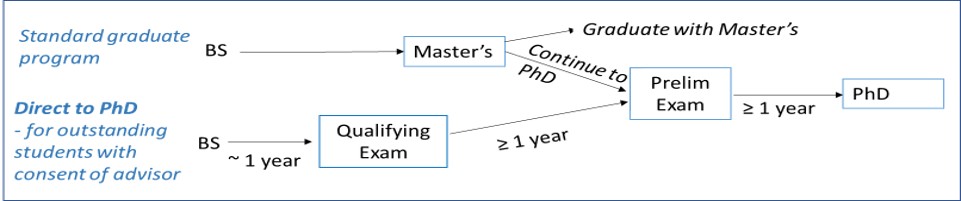
*The Direct to Ph.D. is an alternative track to the Ph.D. for some outstanding students that do not wish to complete an MS.

The purpose of the Qualifying Exam is to ensure that the student is prepared to conduct independent research as demonstrated by the student’s ability to effectively summarize the literature in their research area, propose appropriate hypotheses or research questions that will advance knowledge, and to develop appropriate research studies to test the hypotheses and answer the research questions. Because research areas in Agricultural and Biological Engineering are so diverse, the department has chosen to conduct the Qualifying Exam in a format similar to the Preliminary Exam, including a written and oral component, rather than an exam testing knowledge of prescribed subjects. However, expectations of the student should be consistent with the early time in the degree program, which are very different from the mastery expected at the time of the Preliminary Exam.
 
The Qualifying Exam consists of three parts: 
  1. Student performance in coursework to ensure that the student demonstrates understanding of and ability to apply key principles at the graduate level
  2. Written Research Plan
  3. Oral Exam 
Students should take the Qualifying Exam in the semester after they have completed one year (i.e., fall for those who entered in the fall), and are required to complete it by the end of the following semester (i.e., spring for those who entered in fall).
 
Master’s students who enter the Direct-to-Ph.D. track after the beginning of their graduate study are encouraged to take the Qualifying Exam at the same time as if they had started as a Direct-to-Ph.D. student (i.e., fall of their second year), but may wait until spring if needed. 
 
Coursework Performance: Students on a Direct-to-Ph.D. track must complete at least 12 credits of courses from their Plan of Study before their fourth semester (including summer) at Purdue and maintain an overall GPA of 3.0 or higher. A student who does not maintain this GPA or receives a grade lower than a B in any course may not proceed on a Direct-to-Ph.D. program but may continue on the MS/Ph.D. track.
 
Scheduling the Qualifying Exam: Early in the fall of Year 2, students should schedule the Qualifying Exam with their major professor and committee. They should notify the Graduate Program Administrator at least a week in advance, who will check GPA and send the rubrics and any other information.  
 
Committee for the Qualifying Exam: The Committee for the Qualifying Exam consists of the major professor and at least two other members of the graduate faculty, with at least one member being from outside the Department of Agricultural and Biological Engineering. When the major professor has a courtesy appointment in ABE, the committee should include at least one regular ABE faculty member. This does need to be the student’s final Advisory Committee, which may not yet be finalized at that time. 
 

Written Qualifying Research Plan

Students should prepare a written research plan in a format agreed on with their major professor. In general, it should review literature in the student’s research area, summarize the initial research plan for the Ph.D. work with emphasis on the immediate future work (over the next year), and present preliminary results. While this is not expected to be equivalent to the proposal for the Preliminary Exam, it should be sufficient to show that the student is capable of conducting graduate research based on evidence of critical thinking skills, understanding of the scientific method, and knowledge of relevant subject matter. A typical written research plan for the examination will have the following structure:
  • Introduction, including research objectives
  • Literature review and theory that form the basis for your study
  • Methods and materials you plan to use, based on what you know so far (recognizing they will be expanded and fine-tuned in future years)
  • Any preliminary results (if available) and/or discussion of what you have learned so far
  • A plan for research in the next 12 months
The student should engage consistently with the major professor to coordinate the document and submit the report to the Qualifying Examination Committee at least two weeks before the exam. 
 

Oral Qualifying Examination

The oral examination will be conducted by the Qualifying Examination Committee on the written Research Plan and also subjects of relevance to the area of specialization. The purpose of the oral examination is to provide an early assessment of the student’s knowledge of their discipline, critical thinking skills, experimental and/or computational skills, communication skills, as well as their vision and motivation to complete the Ph.D. They should not be expected to display the same level of mastery that would be expected at the Prelim. The Oral Quals exam will normally be one to two hours, beginning with a short presentation from the student to the committee, followed by questions and additional discussion. Time should be reserved for a closed-door deliberation among the committee members (in the absence of the student) during which the committee will determine the results of the exam, complete the rubric, and provide the results to the student.
 
The student should prepare and print Rubric Forms for each member of the Advisory Committee. 
 

Possible Outcomes of the Qualifying Exam

Based on an evaluation of the student’s coursework and performance in the qualifying procedure, there are three possible outcomes:
 
  1. Pass: The student is admitted to the Ph.D. program and must complete all Ph.D. program requirements to be awarded a Ph.D. degree. (The Qualifying Exam does not replace the Preliminary Exam, which must be completed at least one year after the Qualifying Exam.)
  2. Retake: The student must retake the required part of the Qualifying Exam, which may include the written exam, oral exam, or both. Students admitted in the fall semester must complete the retake by the end of March, i.e., during the Spring semester of their second year. Students admitted in the Spring semester must complete the retake by the end of October, i.e., during the Fall semester of their second year.
  3. Pursue Master’s Degree: The student moves from the Direct-to-Ph.D. track to the master’s degree program (non-thesis or thesis). At the master’s Final Exam, the committee will determine whether the student may be admitted to the Ph.D. program. 

CONCENTRATIONS

A concentration is used to allow a specialized area of graduate study to be reflected on a student’s final transcript. The department currently offers the following:

  • Biotechnology (PULSe program students only)
  • Biotechnology Innovation and Regulatory Science (offered to Purdue Online students only)
  • Computational Science and Engineering (through CIGP)
  • Computational Life Sciences (through CIGP)
  • Data Science for Agricultural and Biological Engineering (DSAG)
  • Fluid Power and Motion Control (FPMC)
  • Interdisciplinary Ecological Sciences and Engineering (IESE)

Approved core courses for these concentrations can be found in Appendix B. Please note that some concentrations offered in ABE are independent of the department. Computational Interdisciplinary Graduate Programs (CIGP), Interdisciplinary Ecological Sciences and Engineering (IESE), and PULSe, an Interdisciplinary Life Science Program, all offer interdisciplinary concentrations in collaboration with the ABE department. Please visit their websites for more information.

GRADUATE CERTIFICATE

Two Graduate Certificates that are popular with ABE students are the Hybrid Vehicle Systems certificate available through the School of Mechanical Engineering and the Geospatial Information Science certificate offered by the Purdue Libraries and School of Information Sciences. Please see their respective websites for information.

A third certificate, Biotechnology Quality and Regulatory Compliance (BQRC) is available for online professional students usually with interest in the online Biotechnology Innovation and Regulatory Science master’s program.

TRANSFERRING TO ABE FROM ANOTHER PURDUE UNIVERSITY GRADUATE PROGRAM

Requirements

The student must meet the OGSPS requirements to be considered by ABE for a transfer from another Purdue department. This means the student’s GPA must be at least a 3.0. The student should be coming from a discipline which closely relates to work done in the ABE department and must be able to demonstrate knowledge of the field of agricultural and biological engineering and articulate how ABE is a good fit for them based on their research goals. Students must have an ABE faculty member willing to serve as their major professor.

Materials Needed to Approve Transfer

  1. A Statement of Purpose for Transfer will be written by the student, explaining which degree they are currently pursuing (master’s or Ph.D.), the justification for the transfer, and explaining why ABE is an appropriate fit for the student.
  2. A letter or statement by the ABE major professor justifying the transfer and indicating a willingness to supervise and provide funding for the student as per the OGSPS requirement.

Process of Assessment

Members of the ABE Graduate Committee will review the file and determine whether the transfer is appropriate for the student and for the department.

2. Major Professor

When admitted to Purdue, most ABE graduate students have already chosen a major professor. If not, they will be initially assigned to one. This initial assignment is based on expressed research interest, the research programs of the staff member, and the availability of research funds. Faculty with courtesy or adjunct appointments are members of the graduate faculties of Purdue and may serve as a major professor or an advisory committee member.

3. Coursework and Plan of Study

COURSE REQUIREMENTS

Courses provide fundamental knowledge needed for graduate students to not only excel in today’s research, but also to be equipped to address new research questions in the future. Therefore, students and their advisory committees should ensure that students take the breadth and depth of courses needed to provide this foundation.

The ABE department has set the minimum requirements described below, but it is appropriate for many students to take more courses to ensure they have the fundamental knowledge needed for current and future research. The ABE department does not have a “common” or “core” set of graduate courses, and students’ degree programs are customized to meet their goals.

Master’s Degree - Thesis

Minimum requirements for the program are 18 course credits beyond the bachelor’s level, and an acceptable research thesis that contributes to knowledge in the field of research specialization. At least half of these credits must be taken at Purdue University. For the thesis option, courses taken must include:

  • At least three credits of graduate coursework (50000- or 60000-level) in any mathematics, statistics, quantitative data processing and/or data science course. (See Appendix D).
  • At least six credit hours of graduate coursework (50000- or 60000-level) in ABE, ASM, or core courses as listed in a specific ABE concentration (see Appendix B).
  • Two semesters of Graduate Seminar:
    • ABE 69400 (typically taken in fall of the first graduate year), and
    • ABE 69600 (typically taken in spring).

Class attendance and participation in Graduate Seminar is mandatory and required for graduation. ABE 69400 and 69600 should not be entered on the electronic copy submitted through the OGSPS.

The plan of study should provide a well-balanced and integrated program in support of the student’s concentration or area of interest. Students should normally complete at least 12 to 18 credit hours of coursework within the first twelve months of the student’s entry into the department, although in cases where the student has a heavy initial research involvement due to the nature of the research, 16 months may be required for coursework completion. The coursework total can include up to three credits of ABE 59000 (see Appendix G for the Special Topics Contract), or an equivalent designation in another department.

A maximum of six hours of 30000 or 40000-level course credits (with a grade “B-” or higher) and any 50000- and 60000-level engineering science or design courses may be listed on the student’s MS degree plan of study if approved by the student’s major professor and ABE Graduate Program. For international students, 30000- or 40000-level courses may count toward the department’s recommended registration total of 10 credits in fall and spring semesters and eight credits in summer only when the course is required for the student’s approved plan of study and degree completion. If the course is not required for the plan of study, it must be taken in addition to the full-time graduate credit load. 

Master’s Degree - Non-Thesis

The non-thesis MS requires 30 semester hours of graduate coursework beyond the BS. At least half must be taken at Purdue University. A non-thesis degree is not a typical route to a master’s degree for ABE students; instead, nearly all ABE students complete thesis-based degrees. For the non-thesis option, courses must include:

  • At least three credits of graduate coursework (50000- or 60000 level) in any mathematics, statistics, quantitative data processing and/or data science course. (See Appendix D.)
  • At least six semester hours of graduate credit (50000- or 60000 level) in ABE, ASM, or core courses if identified in a specific concentration (see Appendix B).
  • One semester of Graduate Seminar - ABE 69400 (typically taken in fall of the first graduate year). 

Class attendance and participation in Graduate Seminar is mandatory and required for graduation. ABE 69400 should not be entered on the electronic copy submitted through the OGSPS.

The plan of study should provide a well-balanced and integrated program in support of the student’s concentration or area of interest. The coursework total can include up to three credits of ABE 59000 (see Appendix G for the Special Topics Contract), or an equivalent designation in another department. Further recommendations for coursework should come from the student's major professor.

A maximum of six hours of 30000- or 40000-level course credits (with a grade “B-” or higher) and any 50000- and 60000-level engineering science or design courses may be listed on the student’s MS degree plan of study if approved by the student’s major professor and ABE Graduate Program. For international students, 30000 or 40000-level courses may count toward the department’s recommended registration total of 10 credits in fall and spring semesters and eight credits in summer only when the course is required for the student’s approved plan of study and degree completion. If the course is not required for the plan of study, it must be taken in addition to the full-time graduate credit load.

Doctor of Philosophy Degree

Minimum requirements for the Ph.D. program are 30 semester hours of graduate work and the completion of an acceptable research dissertation that contributes to knowledge in the field of research specialization. This total can include three credits of ABE 59000 (see Appendix G for the Special Topics Contract), or an equivalent designation in another department. At least half of Ph.D. course credits must be taken at Purdue University, not including credits taken to complete the MS degree. The plan of study should be a well-balanced and integrated program including in-depth work in the concentration or research area of interest, breadth in Agricultural and Biological Engineering, and a sound mathematical background including:

  • At least six credits of graduate coursework (50000 or 60000-level) in any mathematics, statistics, quantitative data processing and/or data science course. (See Appendix C.)
  • At least twelve credits of graduate coursework (50000 or 60000-level) in ABE, ASM, or core courses as identified in a specific concentration. (See Appendix B for course lists.)
  • Three semesters of Graduate Seminar, ABE 69400, ABE 69600, and ABE 69700. The three Graduate Seminar courses are not to be listed on the electronic plan of study.
    • ABE 69400 is generally taken in the first fall semester of graduate studies.
    • ​ABE 69700 is taken after the second year of graduate studies is completed, but before, or in the same semester as, the prelim exam.
    • ABE 69600 is generally taken after the student has compiled enough research results to develop a departmental seminar on their work. 
A maximum of six hours of 30000- or 40000-level course credits (with a grade “B-” or higher) and any 50000- and 60000-level engineering science or design courses may be listed on the student’s Ph.D. degree plan of study if approved by the student’s major professor and ABE Graduate Program. For international students, 30000- or 40000-level courses may count toward the department’s recommended registration total of 10 credits in fall and spring semesters and eight credits in summer only when the course is required for the student’s approved plan of study and degree completion. If the course is not required for the plan of study, it must be taken in addition to the full-time graduate credit load.
 
Up to 18 credit hours may be waived from the requirements of a completed MS degree. These should conform to the requirements for the MS outlined above. Individual courses applied to the MS degree from Purdue University or another institution should not be listed in the Ph.D. electronic plan of study. Instead, the student’s major professor and/or Graduate Program Administrator will enter and approve the total number of semester hours applied from an MS, up to 18 total. 
 

4. Plan of Study

Each graduate student admitted to a degree program must file a Plan of Study through the myPurdue portal before the end of the first semester of graduate work, or in their first fall semester. Plans of Study are discussed and created as a part of the ABE 69400 Graduate Seminar requirements. The Plan of Study includes the specific courses the student is expected to complete. No courses that have S/U grades, such as research credits (ABE/ASM 69800 or 69900), should appear on the Plan of Study, nor should any P/NP classes.

Waiver of course requirements (only for Ph.D. students with a MS earned from Purdue University or another accredited institution) are subject to the rules as described in the last paragraph of section 3 (above) and are subject to the approval of the student’s major professor and ABE graduate committee. Waived courses from another institution will not appear on the Purdue University transcript. Waived courses applied to a MS earned at Purdue University or another institution should not be individually listed in the student’s electronic plan of study. The major professor (or designee) will enter and approve the total number of waived credit hours (≤18) on the electronic plan of study.

Per OGSPS policy, course credits earned by a student whose graduate study and/or professional activity have been inactive for five years or more cannot be used in a plan of study for an advanced degree. A plan of study approved prior to such a period of inactivity is invalid. A preliminary examination passed prior to such a period of inactivity is invalid.

Up to six credits of 30000- or 40000-level course credits, with a grade of B- or better, are allowed on plans of study for both a master’s and Ph.D. degree. For international students, 30000- or 40000-level courses may count toward the department’s recommended registration total of 10 credits in fall and spring semesters and eight credits in summer only when the course is required for the student’s approved plan of study and degree completion. If the course is not required for the plan of study, it must be taken in addition to the full-time graduate credit load. 

FILING THE PLAN OF STUDY

An initial plan of study will be developed as part of each new graduate student’s successful completion of ABE 69400, the Graduate Seminar Course.

The Plan of Study Worksheet (Appendix A) can be used to outline coursework and to assure that the coursework fulfills the requirements described in section 3. The Plan of Study must be approved by the major professor.

The approved worksheet will aid in completing the electronic submission of the plan of study. The Plan of Study is filed electronically and must be completed by the student after his or her major professor has approved. It includes the specific courses the student is expected to complete and other requirements of the degree being sought. No research credits (ABE/ASM 69800 or 69900) or graduate seminars (ABE 69400, 69600, or 69700), should appear on the plan. No courses taken pass/fail (P/NP) or satisfactory/unsatisfactory (S/U) may be included in the plan. The initial Plan of Study must be finalized and submitted for approvals before the end of the first semester in a graduate degree program.

For students who complete an MS degree at Purdue or at another institution, up to 18 credit hours may be waived, subject to the approval of the major professor and the graduate committee. See details above in the last paragraph of Section 3.
 
After the initial electronic plan of study has completed the approval process, it may be amended at any time, subject to the major professor’s and graduate committee’s approvals. 

CREDITS FROM ANOTHER UNIVERSITY

Students who transfer to ABE from another university may transfer graduate courses to fulfill course requirements at Purdue, provided they are approved by the student’s advisory committee and meet the following criteria:

  1. Courses are graduate level and taken at an institution regionally accredited at the graduate level
  2. A grade of B- or better was earned
  3. Credits were not used toward another awarded degree
  4. There is less than a five-year gap between when the courses were taken and the beginning of the graduate program at Purdue University.

The advisory committee should ensure that the courses are suitable for transfer to Purdue and may review the course syllabus or other information before approving. At least 50% of the course requirements for any degree must be taken at Purdue.

RESEARCH AND COURSE REGISTRATION PURPOSE

Registration for all students should reflect the student’s activity as accurately as possible. Any student must be registered for research during each semester or summer session when doing research utilizing faculty direction or consultation, and/or requiring the use of university facilities. Research includes literature reviews and thesis writing. Policy requires that each graduate student supported by an assistantship (teaching or research) must be registered as a full-time student each semester. In fulfilling degree requirements, a maximum of 18 credit hours will be allowed from any one semester (nine credit hours for the summer session.)

Research credits represent effort to reach research goals outside of the employment appointment (usually 20 hours per week for a research or teaching assistantship). Learning to conduct research with mentorship by the advisor is an important part of the graduate student experience and is different than work required by the assistantship. At least one research credit is required for all students in every semester.

  • The ABE Department recommends that students with assistantships (RA or TA) register for a total of 10 credits (course plus research credits) during the fall and spring semesters, and eight credits in the summer. (Note that international students on assistantships must be registered for a minimum of eight credits to maintain legal F-1 status.)
  • Students on fellowships or who are self-funded may register for more research credits if they wish, because they do not have assistantship-based employment responsibilities. (International students who do not have assistantships must be registered for a minimum of eight credits to maintain legal F-1 status, so international students on fellowships may want to register for more than 10 credits to ensure they do not fall below this minimum.)

These are general recommendations, but student circumstances may lead to different levels of research activity in various semesters and therefore graduate students and their major professor should select an appropriate number of credits each semester.

All thesis master’s students must be registered in ABE or ASM 69800 (Research MS Thesis) and all Ph.D. students must be registered in ABE or ASM 69900 (Research Ph.D. Thesis). ABE/ASM 69800 and ABE/ASM 69900 should not appear on the Plan of Study but count toward meeting residency requirements. Early registration is recommended. Late registration will result in additional fees.

RESEARCH REGISTRATION PROCESS

The OGSPS requires that each student complete a “syllabus” for each semester of research credit registration. This includes general goals and expectations agreed upon by a student and their major professor for the semester in question. In ABE, the form found in Appendix E is used both to fulfill this requirement and to allow a process for students to request registration for research credits. The syllabus should be completed by the student and approved by the major professor.

The Research Expectations section includes two parts. The top part is standard and applies to all students each semester. The second part should describe the specific accomplishments expected during the upcoming semester and should be developed by the student and major professor together. This clarification of expectations is very helpful in ensuring smooth progress forward.

After completion, the student should use this form to fill in the corresponding online form: ABE Research Credit Registration Form – Fill out form. The form will route to the faculty member selected as major professor in the form, where they will reject or approve. If rejected, the major professor will explain the changes that need to be made, and the response will be emailed back to the student with the Graduate Program Administrator copied. The student will then need to resubmit the online form.
 
Once approval is given, the Graduate Program Administrator will enter the research credits and communicate with all parties. This must be completed before the end of the first week of a term, or the student will have to use the Scheduling Assistant found in myPurdue.

REGISTRATION AND BILLING

When registration is completed, fees and payment schedules will be posted on the myPurdue portal. It is the student’s responsibility to provide the correct mailing address or direct deposit account information, to the Office of the Registrar, Bursar’s Office, and Agricultural and Biological Engineering Department, for billing purposes.
 
Students employed through an assistantship or fellowship receive tuition remission, which is processed by the ABE Business Office and the Bursar’s Office after they have registered for full-time credits for that term. Please note that some fees are NOT covered by tuition remission. For example, the College of Engineering charges differential fees, and the university charges student health and wellness fees. For more information regarding fees paid by the students, and for information regarding payment plan options, please visit the Bursar’s Office website. Additionally, tuition and fees can be estimated using the Tuition Calculator.

REGISTRATION AND HOLDS

To check if you have a Hold on your account that may prevent registration, please login to your myPurdue and locate the Registration Holds card. Common examples of holds that will prevent you from being able to register or obtain official transcripts are:

  • Immunizations - All Purdue students must have their immunization records on file with Purdue University Student Health (often called PUSH). For office information, see Section 13. 
  • Financial Responsibility - The Division of Financial Aid requires all Purdue students to acknowledge and accept their responsibility for incurred charges. This hold is placed on every student account before spring registration opens each year. For office information, see Section 13.
  • Emergency Contact - The University requires each student list an Emergency Contact. This hold is also placed on every student’s account before spring registration opens each year. If you have an Emergency Contact listed already, you must click “Verify” to remove the hold once it is in place. 
  • Outstanding Admission Conditions (such as missing official transcripts or official diploma) - This is a hold that you may see in your second semester of registration. Many students fail to provide official transcripts or certificates to the OGSPS upon their arrival to Purdue. This hold means you still need to contact the OGSPS Admissions Office to fulfill an admission condition. More information can be found on the How to Apply site.

GRADE REQUIREMENTS

Graduate students are expected to perform at a high academic level. Only grades of “C-“or better are acceptable in fulfilling OGSPS requirements on any plan of study. No more than six credits of "C" grades will be accepted toward graduation. The major professor and the advisory committee may require performance of “B or better” in certain courses. This requirement must, however, be stated in writing to the student and placed in the student’s file at least one month before the student takes the course. This requirement is recorded in the plan of study by checking the appropriate box when entering the course in the plan.  
 
Please note: Pass/no pass grades are not acceptable in fulfilling degree requirements.
 
GPAs Less Than 3.0
 
Graduate students are expected to maintain a cumulative GPA of at least 3.0 (B average) throughout their studies. If the GPA falls below 3.0 in any semester, the major professor and graduate program chair will meet with the student to develop a plan for improvement. If the GPA remains below 3.0 for another semester, the department head will work with those involved to develop a course of action. If the GPA does not improve after one academic year, various actions will be considered, including dismissal of the student.
 
The graduate program administrator (Nikki Zimmerman) will monitor the GPA of all students at the end of each semester, including summer. If any are below 3.0, she will email the student, their major professor, and the graduate committee chair. The major professor is expected to set up a meeting with the student and the graduate program chair to discuss the changes they plan to make to improve their GPA. Specific steps should be written into a plan, which should be accepted by the student and the major professor. 
 
In situations where a graduate student does not satisfactorily complete a graduate level course with a grade of “C” or better, the student may re-enroll in the course only once. The first grade will be Excluded from the cumulative GPA and marked as such on the academic transcript. If a student receives a “D” or below in more than one course, the student could lose his/her departmental graduate appointment. 
 
Graduate students who receive an incomplete grade in any course (including research) will have one year from the date the Incomplete was given to receive a completion grade. If that is not done, the Registrar’s Office will convert the grade to failing (noted as IF/IU on the official transcript).
 
Unsatisfactory “U” grades
 
Graduate students are expected to maintain satisfactory academic, research, and professional progress throughout their studies. A grade of “U” in research, seminar, independent study, or any other graduate course that uses satisfactory/unsatisfactory grading indicates that the student’s performance or progress did not meet the expected standard for that enrollment period. If a student receives a “U” grade in any semester, the major professor and graduate program chair will meet with the student to review the concern and develop a written improvement plan. The plan should identify the issue, specify corrective steps and expectations, set a timeline for review, and be accepted by the student and major professor.
 
The graduate program coordinator (Nikki Zimmerman) will monitor “U” grades at the end of each semester, including summer, and notify the student, major professor, and graduate committee chair when a “U” grade is recorded. If the student receives a second “U” grade, fails to address the concern within the agreed timeline, or has an unresolved “U” grade in required research, thesis, independent study, or other required graduate work before graduation, the department head will work with the appropriate parties to determine a course of action. Possible actions may include revising the improvement plan, limiting continued registration for research credits, modifying research expectations, changing the advising arrangement when appropriate, placing the student on departmental probation, or recommending dismissal from the graduate program.
 
REGISTRATION REQUIREMENTS
 
The OGSPS require that one-half of the total credits for the master’s degree and one-third of the total credits for the Ph.D. degree be earned at Purdue University. The ABE Department requires one-half of the total credits for each degree be earned at Purdue University. (See VI., B. Degree and Registration Requirements.)
 

5. Graduate Research

ADVISORY COMMITTEE

Each student completing the Quals, a thesis master’s degree, or Ph.D. degree must select an advisory committee. The major professor will help identify faculty members who have expertise in the area of research or professional interest.  The advisory committee will advise on courses selected for the plan of study, and as needed during graduate studies. Since the advisory committee must approve plans of study, research project outlines, and theses, the student is responsible for keeping committee members informed of his/her progress. Failure to meet the filing deadlines may result in loss of a student’s graduate assistantship, until the process has been satisfactorily completed.
 
The advisory committee for the Quals and a master’s degree consists of the major professor and at least two other members of the graduate faculty. For a Ph.D. degree, the advisory committee should consist of the major professor and at least three other members of the graduate faculty, with at least one member being from outside the Department of Agricultural & Biological Engineering. When the major professor has a courtesy appointment in ABE, the advisory committee should include at least one regular ABE faculty member for both master’s and Ph.D. degrees.
 
INTEGRITY IN RESEARCH
 
Integrity in research is an essential part of Purdue University’s intellectual and social structure, and adherence to its spirit and principles must be maintained. These principles include commitment to truth, objectivity, fairness, honesty, and free inquiry. Violations of integrity may result in dismissal from the university.
 
Serious violations of integrity in research are rare. However, those that do occur strike at the very heart of scholarship and the concept of the university. Advances in scientific knowledge depend on reliable data and honestly reported conclusions. In any academic institution, scholars, researchers, and artists have a special obligation to exemplify the best qualities and highest standards of personal and professional conduct.
 
All ABE students are required to complete the online training course on Responsible Conduct of Research developed by the Collaborative Institutional Training Initiative (CITI).  This is an assigned requirement of the ABE 69400 seminar. Students should also be familiar with policies on responsible conduct of research at the above website.
 

6. The Preliminary Exam for Ph.D. Students

Admission to candidacy for the degree of Doctor of Philosophy takes place only after the student has passed the preliminary examination. (Note that this is not the same as candidacy for graduation.) A student must be enrolled for at least 2 full semesters (summer is counted as a semester) between successful completion of the preliminary exams, and the defense of the dissertation, (e.g., If the prelim is completed in fall 2026; the final defense can be held in fall 2027 or later).
 
The preliminary examination consists of three parts: 1) research proposal, 2) written examination, and 3) oral examination. The preliminary examination is administered by the student’s major professor and the preliminary examining or thesis advisory committee. It determines if students have an adequate understanding of their research program, have a reasonable plan for completing the research, and have the necessary academic background and capability to conduct the research successfully. The process should be determined and scheduled with the entire committee well in advance, usually early in the semester during which the prelim will take place. 
 
The research proposal should follow a format determined by the student’s major professor and preliminary examination/thesis advisory committee. Specific expectations for the format, length, and content of the research proposal should be set by the major professor and communicated to the student. The research proposal should be submitted to the examining/thesis advisory committee before the written prelim takes place and at least three weeks prior to the oral examination.
 
The format and content of the written examination are developed by the student’s major professor and the preliminary examining/thesis advisory committee. The ABE Department expects that the written examination should include subject matter other than material directly related to the student’s specific Ph.D. research topic and that it should be at a level that requires the student to demonstrate expertise in the subject matter. Often each member of the committee provides one or more questions. Types of questions that may be used include critiquing an article selected by a committee member, writing a short proposal on a problem different than the student’s research proposal, or solving a problem related to the proposed research. The written examination process should be clearly communicated to the student in advance, including the day and time each member of the committee will provide the question(s). Each committee member should provide instructions for their question(s), the time allowed (often 4 to 24 hours), and allowable resources to be used. The entire process should normally take less than two weeks, including all questions and breaks between them. The completed questions will be submitted to the major professor and preliminary examining/thesis advisory committee, and results will be returned to the student in a timely manner. The written exam must be passed before proceeding to the oral exam.
 
The oral examination should include a presentation by the student summarizing their research proposal. As students should meet with their advisory committee annually to discuss their research progress, the presentation typically provides an update on prior results or a summary of work to date. Most of the oral presentation should focus on the proposed methodology, data collection plans, data analysis, anticipated results, and timeline. The exact format, length, and content should be followed as directed by the major professor. The preliminary examination/thesis advisory committee is expected to ask the students questions about their research and other relevant topics, including material from their written exam.
 
At least two weeks prior to the oral examination, a Request for Appointment of Examining Committee (electronic G.S. Form 8) must be filed by the student and approved by the student’s major professor.  At or after the oral exam, committee members will be asked to complete the Rubric for Ph.D. Dissertation Research Proposal, Written Prelim, and Oral Prelim. 
If the report of the examining committee is unfavorable, the student may repeat the examination after the following semester or summer session at the recommendation of the examining committee. Should the preliminary examination be failed twice, the student may not be given a third examination, except on the recommendation of the examining committee and with special approval of the Dean of the OGSPS. 
Please refer to the following chart for a simplified outline of this timetable:
 

Preliminary Exams Timeline

Timeline Actions
Near the beginning of the semester in which you take your Preliminary Exams. 
  • Confirm that your Plan of Study has been approved by the OGSPS. Make any necessary changes.
  • Discuss the schedule and format for your written and oral preliminary exams and research proposal with your major professor. Select a date for the oral prelim, recognizing that the written prelim must be passed before proceeding to the oral. 
 
Several weeks before the Oral Preliminary Exam.
  • Submit your Research Proposal to your committee
  • Take your Written Preliminary Exam
 
At least 2 weeks before the Oral Preliminary Exam.
  • Submit electronic Form 8 (Request for Appointment of Examining Committee) for approvals. Once Form approved by OGSPS, final approval email is sent to Graduate Admin, who will email the necessary rubrics to the student.
At the Oral Preliminary Exam
 
  • The major professor directs the exam, which normally includes a presentation by the student, followed by questions related to the written exam and the proposed research.
  • At the end of the exam, Committee members should complete the “Ph.D. Dissertation Research Proposal, Written Prelim, and Oral Prelim Rubric”.
  • The major professor should initiate the exam results form, which will then be completed by other Committee members. 
 

7. Thesis and Defense

DECLARING CANDIDACY FOR GRADUATION
 
Graduate students must declare candidacy for the semester in which they intend to defend their thesis or dissertation and have their degree awarded.  The OGSPS Deadlines Calendar provides the dates by which requirements must be completed, normally 1-2 weeks before the end of the semester. It is the student’s responsibility to communicate graduation intentions with their major professor and the Graduate Program Administrator during the registration period for any given semester. Candidacy for graduation is only valid for one semester and does not carry forward to other semesters if the thesis/dissertation defense and submission deadlines are missed.  Should a student miss the deadlines for graduation, they can register as many times as needed.  However, any student registered for candidacy in three consecutive semesters will be assessed a $200 fee by the OGSPS upon the third registration and in each consecutive semester following it.
 
A “CAND” course, either 99100 or 99200 should appear on the student’s registration for the appropriate semester of their graduation.
 
It is the student’s responsibility to confirm that the coursework on their plan of study matches the coursework completed at Purdue.
 

Appropriate CAND course registrations:

     CAND 99100 (General                   Candidacy)                           

CAND 99200 (Degree Only)
Students plan to fulfill all requirements during the semester. (See OGSPS Deadlines Calendar for due dates.)             Students must have met all degree requirements, except for defending and/or depositing. Satisfactory research is required in the previous session, and students must meet a mid-semester deadline.

CAND 99200 is considered a “privileged registration” status which results in lower fees, but not in full-time student status.  As a general rule, students registered for CAND 99200 may NOT be funded (supported on an assistantship). Be aware that most students who select CAND 99200 leave campus before semester’s end.

 
THESIS OR DISSERTATION
 
The final product of most graduate research programs is a thesis or a dissertation. This document represents the diligent and original work of the student. Care should be taken to be sure this document is of high quality. The thesis or dissertation must be distributed to the advisory committee at least two weeks before the final exam is given.  In their written document, students must demonstrate that they have met the expectations of Ph.D. graduates (i.e., that they are able to critically analyze existing literature to identify gaps in their research area, design methodologies to address these gaps, employ appropriate tools or techniques to conduct their work, and rigorously analyze, interpret, and communicate their findings to advance their field). It is also expected that students will demonstrate adherence to principles of responsible research conduct throughout their dissertation. Please visit the Thesis/Dissertation Office’s website for instructions regarding formatting, running iThenticate, and other submission questions.  
 
The OGSPS require a specific format for all theses and dissertations. Detailed information on formatting your thesis or dissertation can be found at the OGSPS’s Thesis/Dissertation Office Website. Each student is responsible for completing and submitting these as required by the OGSPS.  In the ABE Department, authority for approving the thesis/dissertation format has been delegated to chairs of the final examining committee.
 
FINAL EXAMS
 
Determining when a student is prepared to defend is a collaborative decision between the student and major professor, based on mutual agreement that the student has fulfilled Ph.D. requirements. A final oral examination is taken after the completion of all course work and the thesis or dissertation. This exam may cover any material in the candidate's program but is typically a defense of the thesis or dissertation. In the case of Ph.D. candidates, at least two full registered terms (which may include summer) of devoted research must lapse between passing the preliminary exam and taking the final defense. 
 
The OGSPS mandates strict deadlines for defense scheduling and dissertation submission, therefore, students are advised to confirm deadlines several months before their intended graduation date.
 
Final examination requests must be approved by the Department Head and received by the OGSPS at least two weeks before the examination date. A final oral examination will be given to candidates before the completion of requirements of the graduating student. Once you have passed the final examination for your degree, your chair and examining committee members will electronically sign the OGSPS Examination Report (GS Form 7 for master’s candidates or Form 11 for doctoral candidates). Once other required signatures are secured, the report is finalized in the OGSPS.
 
Students should have electronic or paper copies of the appropriate ABE rubrics for each member of their committee.  Committee members should complete the rubric forms and submit originals or copies to the Graduate Program Administrator and provide a summary to the student.
 
Expectations for Ph.D. Defense
 
During the oral defense, students must demonstrate that they have met Ph.D.-level expectations, including the ability to critically evaluate literature, identify research gaps, design and execute methodologies, analyze results, and communicate findings effectively to advance their field. Students must also show adherence to ethical research practices.
 
While there is no fixed requirement for published papers, a common benchmark is to aim for two accepted or published journal articles by the defense date, with additional manuscripts in preparation.
 
THE DEPOSIT PROCESS
 
Both MS and Ph.D. theses/dissertations are required to be submitted electronically to the Purdue OGSPS for review. An electronic PDF file of all theses/dissertations will be uploaded to the Hammer Research Repository (HammerRR). A final copy of the thesis/dissertation should be delivered to the major professor and committee members, or as the major professor dictates. Please visit the Thesis/Dissertation Office’s Deposit Process website for more information. Note that the deadline to submit the Form 9 and the thesis or dissertation is 24 hours before the published deadline.
 

8. Other Policies

STUDENT CONDUCT
 
Graduate students, like all students officially enrolled at Purdue University, are subject to all university regulations. At the same time, their rights as individuals and as students are duly protected. Graduate students who feel that their rights have been violated by a disciplinary decision may seek redress through the Community Standards Board, according to procedures specified in Regulations Governing Student Conduct, Disciplinary Proceedings, and Appeals in the University Regulations, Student Conduct Policy.
 
ACADEMIC STANDARDS
 
Graduate students must be proactive in matters pertaining to their academic program, coursework, and research.  It is recommended that all graduate students in ABE meet with their major professor at the beginning of each semester to be certain both the student and major professor understand and agree upon expectations regarding registration, research credits, and other academic matters.  While this should help avoid any major issues before they arise, there are OGSPS and University processes in place should more guidance be necessary.
 
Graduate students who wish to appeal decisions concerning matters of academic standards may seek redress according to procedures specified in the Student Conduct Policy, Regulations Governing Student Conduct, Disciplinary Proceedings, and Appeals, Section E - Grade Appeals System, of University Regulations and to the procedures detailed in Graduate Council Document 91-C which have been established in accordance with the authority thereby delegated to the Graduate Council.  Further information regarding graduate student Appeals Concerning Academic Standards can be found in the Policies and Procedures for Administering Graduate Student Programs, section IX, A. Student Conduct and Rights of Appeal.
 
NONDISCRIMINATION POLICY STATEMENT
 
Purdue University is committed to maintaining a community which recognizes and values the inherent worth and dignity of every person; fosters tolerance, sensitivity, understanding, and mutual respect among its members; and encourages each individual to strive to reach his or her own potential. The University believes that intellectual and cultural diversity among its many members strengthens the institution, stimulates creativity, promotes the exchange of ideas, and enriches campus life.
 
Purdue University views, evaluates, and treats all persons in any University related activity or circumstance in which they may be involved, solely as individuals on the basis of their own personal abilities, qualifications, and other relevant characteristics.
 
Purdue University prohibits discrimination against any member of the University community on the basis of race, religion, color, sex, age, national origin or ancestry, genetic information, marital status, parental status, sexual orientation, gender identity and expression, disability, or status as a veteran. The University will conduct its programs, services and activities consistent with applicable federal, state and local laws, regulations and orders and in conformance with the procedures and limitations as set forth in Purdue’s Equal Opportunity and Equal Access policy which provides specific contractual rights and remedies.
 
Any question of interpretation regarding this Nondiscrimination Policy Statement shall be referred to the Vice President for Ethics and Compliance for final determination.
 

9. Professional Development

PROFESSIONAL SOCIETIES
 
Attendance at professional meetings and membership in professional societies is encouraged. In most cases travel and lodging are the students’ personal responsibility except in cases where project funds are available for this purpose. The Department often arranges a van to attend the annual American Society of Agricultural and Biological Engineers meeting. Many professional and research associations have branches on campus such as Sigma Xi and Alpha Epsilon. Students are expected to be active in professional societies while pursuing advanced degrees at Purdue University.
 
ABE GRADUATE STUDENT ASSOCIATION
 
Students are strongly encouraged to participate in the Agricultural and Biological Graduate Student Association. As an admitted graduate student in the Agricultural and Biological Engineering Department, students are automatically members. Your level of participation in the organization is your decision. The ABE GSA Executive Board is made up of graduate students dedicated to improving the experience of their fellow graduate students in the ABE department at Purdue University. 
 
GRADUATE STUDENT AWARDS
 
As part of both the College of Agriculture (COA) and the College of Engineering (COE), graduate students in the ABE department may be eligible for many awards annually. Award opportunities that are typically offered annually are listed below, although any of these may change each year. The Graduate Program Administrator sends email notification to all graduate students of specific awards, application materials needed, and deadlines, which graduate students are responsible for meeting if they wish to be considered. 
 
The list below includes those that are evaluated and decided upon in the department, including those awards for which we nominate a candidate who may or may not receive the award. A brief, partial description is given, please see actual award criteria for specific information.
 
Graduate student awards and typical deadlines
Award Typical Deadline
(subject to change)
Description
Mentoring Award for Ph.D. Students (Nomination to OGSPS) January Based on sustained mentorship throughout Ph.D. program assisting undergraduate and other graduate students
Excellence in Postdoc Mentoring Award (Nomination to OGSPS) January Recognizes Postdocs who dedicate significant time and energy to other postdocs, grad student and undergrad students
OGSPS Excellence in Teaching Award (Nomination to OGSPS) January Evidence of excellence in teaching, mentoring, professional development, and engagement activities focused on teaching
Outstanding Graduate Research Award (COE) February Based on publications, awards for research and contribution to research field and society
Magoon Teaching Award (COE) February Must have half-time teaching assistantship and other eligibility as determined by COE
Outstanding Graduate Service Award (COE) February Service to the department, college, university, and community
Outstanding Postdoc Award February Demonstrated excellence in research, teaching, mentoring and/or service.
ABE Outstanding MS and Ph.D. Awards March Based on research contributions, academic excellence, teaching or mentoring, and service to ABE
Bilsland Dissertation Fellowship  December For Ph.D. students in final year. Selection based on funding need, merit, service, and career promise

10. Graduate Student Employment

WORKLOADS OF STUDENTS WITH GRADUATE STAFF APPOINTMENTS
 
Most graduate students in the Agricultural and Biological Engineering Department are supported by half-time research assistantships (50% RA) or teaching assistantships (50% TA). A half-time appointment constitutes a contract for 20 hours of service per week. If an assistant’s duties are independent of the student’s course work and research, the definition of the half-time workload is relatively straight forward: not more than 20 hours per week. 
 
Any research relating to a graduate student’s degree is not included in the 20 hours and must be done in addition to the 20 hours the half-time appointment involves. Nearly all students will register for research course hours (ABE 69800 or ABE 69900) every semester to account for the time spent on research in the lab, field, or desk each week beyond their work as a research or teaching assistant. Disputes between graduate assistants and major professors should be discussed between the parties involved and moderated by the Department Head if necessary. Contact the Graduate Program Administrator with questions. See the Purdue University OGSPS Policies and Procedures for Administering Graduate Student Programs in the University Catalog for additional information.
 
Any appointment over 50% FTE (20 hours per week) must be approved by the OGSPS and the office of International Students and Scholars (ISS) if applicable.
To be eligible to hold a graduate staff appointment during any session, an individual must be enrolled as a degree-seeking graduate student and be registered full time for the duration of each semester during the entire appointment period. Graduate staff on appointment during the summer are obligated to register for full-time status during at least one of the summer modules.
 
DIRECT-TO-PH.D. STIPEND
 
Students interested in the Direct-to-Ph.D. program and who are on assistantship will earn a stipend equivalent to that of an MS student until a determination is made following completion of the Quals. If the student successfully advances to the Ph.D. program, the student will receive a stipend at the Ph.D. level beginning the semester following the one in which the student takes the qualifier and subject to the availability of funds and continued satisfactory performance. If the determination is that the student retakes the qualifier or first completes an MS before advancing to the Ph.D., the student will remain on an MS stipend subject to the availability of funds and continued satisfactory performance. Funding support for students set to graduate with MS degree will be at the discretion of the major professor and the Department Head.
 
VACATION AND SICK LEAVE POLICY
 
As staff of the department, graduate research assistants receive 22 days of vacation per fiscal year. These vacation days do not automatically occur during university breaks, unless vacation is requested. Vacation or other absences from the Department can be requested through SuccessFactors. Those graduate assistants employed only during the academic year are not paid during university breaks and are not required to use vacation.
 
Graduate student fiscal-year staff terminating their employment with the University forfeit any unused vacation allowance. This allowance will not be paid to the staff member, nor may their appointment be extended to cover any unused vacation.
 
Official holidays are announced annually by Purdue’s president and provide for additional leave days. 
 
Up to two weeks (10 working days) per year sick leave and 15 working days per year military leave (with pay) may also be granted. Benefits-eligible graduate staff are eligible for paid bereavement leave due to death in the immediate family. Up to five workdays over six consecutive calendar months are allowed. Up to one workday for the death of extended family members, or fellow employees. All graduate students must complete a sick leave form upon returning to work for time missed due to illness. 
 
For specific details regarding leave, bereavement, sick leave, etc. please see the Graduate Student Employment Manual and the Graduate Student Staff Benefits policy.
 
STUDENT OFFICES
 
Graduate students that are employed by the ABE Department are assigned office space, as available, when they begin their studies. The ABE Executive Assistant, Becky Peer, assigns office spaces. Any requests for changes in the graduate student offices must be submitted to her.
 
KEYS
 
Graduate students are assigned keys so they can enter labs and office spaces. A key request form can be obtained from the ABE Facilities and Equipment Manager or ABE Executive Assistant. The form should be signed by the major professor and returned to obtain keys. Keys must be returned and the proper space on the checkout sheet signed by the Department Head before your degree will be awarded and your last paycheck approved.
 
All ABE outside doors are open to the public Monday- Friday 6 a.m. to 8 p.m. Card tap access for exterior doors and 3rd through 5th floors can also be obtained by contacting the ABE Facilities and Equipment Manager or ABE Executive Assistant.
 
Please keep in mind that Safety Training may be required before access is given. 
 
TRAVEL
 
Travel Requests and Reimbursement
Travel requests and reimbursements must be submitted through Concur.  The link to Concur can be found within the OnePurdue portal.  Students traveling must obtain a valid account number and approval from their major professor.   
• Before traveling, review the travel guidelines.
• The business office can only pre-pay registration fees on departmental credit cards.
• Obtaining a travel card is a 2–3-week process. Allow plenty of time!
• Registration fees must be reimbursed through Concur and not the purchasing center.
• Students can request pre-payment of airfare and lodging through AAA. The process can be found on the Travel website. You must complete a travel request for each expense being paid. Make sure you complete the process, or the reservations will be canceled within 24 hours.
• Because travel cards can only be used to pay for expenses of the card holder, if you share a hotel room, you must have the hotel split the expense and charge each individual.
• Combining personal time and business travel requires additional documentation. Failure to collect this documentation prior to the trip could cause you money. Follow the travel guidelines found on the travel website.
 
Departmental Vehicles
Vehicles are available in ABE for transportation on project work. Students using these vehicles must possess a valid U.S. drivers’ license.  Please be aware that you will need to allow approximately 2 weeks for processing of Driver Authorization Requests, which must be secured PRIOR to your first use of a Departmental Vehicle. The Driver’s Authorization form is completed through iLab under ABE’s Vehicle Recharge. Please inquire through the Business Office about the process.
 
ABE Vehicles are to be reserved through the iLab System, which requires a valid account number, and this account will be charged for the miles driven. Keys can be obtained for those vehicles from the Main Office. The Main Office can help with this process. Vehicle problems and accidents are to be reported to the Building Deputy. Seat belt use is mandatory in all university vehicles. You must record the mileage driven on the log sheet in the vehicle.
 
Requests for university-related travel must be approved, and funding must be obtained from your supervisor prior to the trip.
 

11. Resources for Graduate Student Research

SAFETY TRAINING
 
All graduate students are required to complete online safety training as appropriate for their work. This will include at least Hazard Communication or Laboratory Safety Fundamentals, and additional trainings as required in each lab space. The training will be online but facilitated by the ABE Department Safety Committee Co-chairs. Each lab has a Safety Committee member assigned as a resource for questions about safety training, or other safety concerns.
 
BUILDING ISSUES
 
Any building or equipment issues should be reported as soon as possible to Tyler Finley, ABE Facilities and Equipment Manager. Please be aware of your surroundings and email Tyler at tjfinley@purdue.edu or call him on his cell phone at (765) 585-7117.
 
FABRICATION OF RESEARCH EQUIPMENT
 
All graduate students are required to attend a Hazard Communication training session. This will include a short segment on the proper use of Personal Protective Equipment. The training will be conducted in the ABE Department by the Safety Committee Chair.
 
SHOP
 
The express purpose of the shop is to build or assist in building research apparatus along with assisting with senior design projects. It is not for personal use. The procedure for obtaining assistance in the shop is as follows: (1) in consultation with your major professor determine what type of equipment is needed for your research; (2) develop an engineering drawing clearly showing the apparatus desired, giving necessary dimensions, sizes, type of material, and notes for its fabrication; (3) provide an account number for acquisition of components and material; (4) discuss your project with the Shop Manager. In some cases, it may be necessary for you to assist the Shop Manager or his assistants in the work.
There is a short safety training course required for students to work in the Shop. Students with Machine Shop experience are allowed to assist with projects. 
 
TOOLS
 
Tools may not be borrowed from the ABE Shop without permission from the Shop Manager. Return tools as promptly as possible. If you break a tool, inform the Shop Manager so it can be replaced or repaired.  Contact Logan Heusinger with shop questions at lheusing@purdue.edu. 
 
RESEARCH MACHINING SERVICES
 
Research Machining Services (RMS) is equipped and staffed to perform work requiring precision machining, machining on large work pieces and specialized fabrications which cannot be performed economically in departmental machine shops. Material for student projects can be purchased from RMS by going through the ABE Machine Shop Manager. Work orders are available from the Machine Shop Manager and must be submitted by the Machine Shop Manager.
 
PRINTING AND PHOTOCOPYING
 
Use of the photocopiers for research must be approved by your major professor. Duplicating services are also available at several locations on campus. Each student is expected to pay the cost of reproducing their thesis/dissertation. Physical copies of the thesis/dissertation are not required for submission, but students should ask their major professor if they want a physical copy before printing.
To make copies for your major professor, obtain their copy code from them.  See the main office for help.
 
POSTER PRINTING
 
Requests to print posters can be sent to Yvonne Hardebeck (hardebey@purdue.edu) or Dan Taylor (taylordc@purdue.edu). 
Please keep in mind that posters cannot exceed 42 inches on one side.
 
1. Be sure to have someone review your poster and double check everything. We only print posters 1 time, unless something doesn’t print correctly. Example: If you forget to put a name on your poster, we will not reprint it. If a graph looks correct on the digital version, but when printed does not look correct, we will re-print as long as you are fairly sure you have corrected the problem. NO REPRINTS are allowed on glossy paper. 
 
2. When you send the poster to be printed, let us know the dimensions.
 
3. 24 hours advanced notice is most helpful. If everything goes right, we can print things quickly. But things don’t always go well with the poster printer, and finding time to change paper rolls, etc. is not always easy.
 
PURCHASING SUPPLIES
 
Laboratory Supplies can be obtained from Fisher Stores located in LILY. You must obtain a valid account number from your major professor and present the account number at the store.
 
Most supplies and equipment should be ordered by regular requisition. The supplies and equipment must be approved by the major faculty member in writing, and the approval must indicate a valid account number. Once approvals have been obtained, the student should submit the order using the TDX system. The processing time of the order is determined by the amount and the vendor. The larger the order, the more approves are necessary and the more time is needed. A small order would only take 1-5 business days. 
 
Additional information concerning the order process and requirements can be found at https://ag.purdue.edu/department/business-office/purchasing-center/index.html. Students can check out the departmental credit card for purchases from local vendors from the Business Office with the approval of their major professor. This approval must be in writing and document the account number to charge. The department credit cards cannot be used online.  
 
Please contact the Business Office with any questions concerning purchasing at boff_ageng@lists.purdue.edu.
 

12. Beyond Research: Taking Advantage of Life at Purdue

Purdue University, as one of the world’s great universities, provides valuable opportunities for learning beyond the classroom, laboratory, and field research sites. While you have many responsibilities to fulfill as an ABE graduate student researcher, you are also encouraged to take advantage of the unique resources to which you have access while you are a student here.
 
• Getting to know other ABE graduate students is a great benefit of being at Purdue. The ABE Graduate Student Association works to foster a sense of community among ABE graduate students through organized social activities, philanthropy events, mentoring, and professional development programs, and all graduate students are encouraged to participate. Purdue ABE graduate students come from around the world, and being part of such an international community is an opportunity to get to know and celebrate our diverse cultures that you are unlikely to have again in the future.
 
• Extracurriculars: ABE graduate students are active in many extracurricular activities, including organized athletics, classes at the co-rec, activities at the LGBTQ center, religious activities, and cultural centers, or clubs of many nations and cultures. Purdue’s clubs representing many interests can be found at https://boilerlink.purdue.edu/. These activities can provide balance and enrichment in your life while serving others, and graduate students are encouraged to get involved.
 
• Graduate Women in Engineering organizes networking and professional development events. https://engineering.purdue.edu/WiE/current-students/community-building/grad-wie-network.
 
• Personal development: Purdue offers courses in a wide variety of topics, and registration for additional courses (up to 18 credits in the fall and spring, and up to 9 credits in the summer) does not increase your tuition. Talk with your major professor about taking additional courses to meet your professional and personal development goals; in most cases if you keep up with your research and plan of study, it will be welcome. These courses will not count towards your degree requirements. You can also audit courses if you receive permission from the instructor and register as an auditor through the appropriate process required by the Registrar’s Office.
 
• Health and Wellness: Purdue provides a variety of health and wellness programs including general wellness, nutrition services, massage therapy, and more. For more information, please visit https://www.purdue.edu/recwell/programs/wellnessPrograms/.
 
• Purdue Basic Needs Program provides support to students by coordinating with campus and community partners, identifying community resources available to students, connecting students with resources for which they may be eligible. While the program does not provide direct financial aid, there are multiple ways to explore available resources. Visit  Basic Needs Program website, or email basicneeds@purdue.edu.
 
• The OGSPS provides links to many opportunities at  https://www.purdue.edu/academics/ogsps/current-graduate-student-resources/.
 
• The OGSPS Office of Graduate Assistance has an ombudsman, as well as many helpful resources from landlord and lease issues, to parking, and academic and mental health resources linked here: https://www.purdue.edu/academics/ogsps/academics/office-of-graduate-assistance-oga/helpful-information/. 


13. Important University Offices & Their Duties

Purdue Fire: (765) 494-6919

Purdue Police: (765) 494-8221 

University Parking Services                     
MMDC
700 Ahlers Dr 
West Lafayette, IN 47906
(765) 494-9497
- Get a parking permit
- Appeal a parking ticket
 
Card Services Office
Stewart Center, room 194
(765) 496-0444
- Get your student identification card
- Add money to your Boiler Express Account
 
Purdue IT
Customer Service Centers located in 
HIKS or WALC
(765) 494-4000
- Ask questions about your student email account
- Get computer/IT support of any kind for campus
accounts and devices
 
PUSH (Purdue University Student Health)
601 Stadium Mall Dr.
(765) 494-1700
- Immunization requirements
 
The OGSPS
Young Hall, room 170
(765) 494-2600
-  Admissions and turn in original documents
-  Fellowship Office
-  Thesis and Dissertation Office
-  Office of Graduate Assistance - Ombudsman services: https://www.purdue.edu/gradschool/student/oga/index.html  
 
International Students and Scholars (ISS)
Young Hall, 5th floor
(765) 49-5770
-  Immigration services
-  International student Orientation
-  Visa questions, issues
 
Office of the Dean of Students
Schleman Hall (formerly Recitation Building), 2nd floor
(765) 494-1747
-  Find a student organization to join
-  Disability Resource Center
 
Office of the Registrar
Stewart Center, room 176
(765) 494-6165
-  Course registration issues
-  Holds
-  Schedule changes
-  Transcripts
-  Commencement and diploma questions
 
Bursar’s Office
Stewart Center, room 194
(765) 494-7570
-  Pay tuition or fees
-  Aid disbursement
-  Fee deferment
 
Division of Financial Aid
Stewart Center, room G18
(765) 494-5050
-  Financial assistance eligibility
-  Grants and loans


14. ABE Staff Directory & Duties

 
Graduate Program Administrator – Nikki Zimmerman, ABE, room 1041   nzimmerm@purdue.edu
& Yvonne Hardebeck (Academic Program Coordinator), ABE, room 1044  hardebey@purdue.edu
• Contact when you need help and/or when you do not know where to start 
• Contact when you have questions about anything- departmentally, university-wide, West Lafayette/Lafayette area, or pretty much anything else
• Support – academic, emotional, whatever…
• Plans of Study & Registration
• Filing prelim, defense, or graduation forms
• You can also check the Padlet for more info!
• Contact Yvonne for poster printing
 
ABE Business Office – Kathy Best, Suzanne Havens, and Rachel Mithoefer, ABE, room 1021
• Travel 
• Purchasing
• Payroll
• Information regarding student insurance, time off for students on assistantships, etc.
 
Assistant to the Department Head & Academic Coordinator – Dan Taylor, ABE, room 1033
• Able to help in Nikki’s absence
• Undergrad Recruiting
• Anything that needs departmental action – start with Dan
 
Executive Assistant to the Department Head – Becky Peer, ABE, room 1005D peerb@purdue.edu 
• Things related to Dr. Mosier
• Desk assignment and keys
• Room scheduling
• Reserve departmental vehicles for driving off-campus (pre-registration required)
• Mail questions
 
Lab Managers – Logan Heusinger, ABE 1005A, and Amanda Limiac, ABE 1005B
• Safety training
• If you TA an undergraduate course with a lab, they can help. Address any Shop questions to Logan.
• Lab equipment and space questions
 
Shop Manager & Building Deputy – Tyler Finley, ABE, room 1005C
• Building issues
• Safety training
• Fabrication of equipment for research
• Vehicles
 

Appendix A-G

APPENDIX A: PLAN OF STUDY WORKSHEET
 
APPENDIX B: CORE COURSES FOR CONCENTRATIONS
 
APPENDIX C: GRADUATE COURSES PER FACULTY AREA OF INTEREST
 
APPENDIX D: RECOMMENDATIONS FOR FULFILLING THE  
                         MATHEMATICS/STATISTICS/DATA SCIENCE 
                         REQUIREMENT
 
APPENDIX E: ABE SYLLABUS FOR RESEARCH CREDITS
 
APPENDIX F: FORMS AND RUBRICS FOR EXAMINATIONS
 
APPENDIX G: ABE/ASM 59000 SPECIAL TOPICS CONTRACT 
                         INSTRUCTIONS